
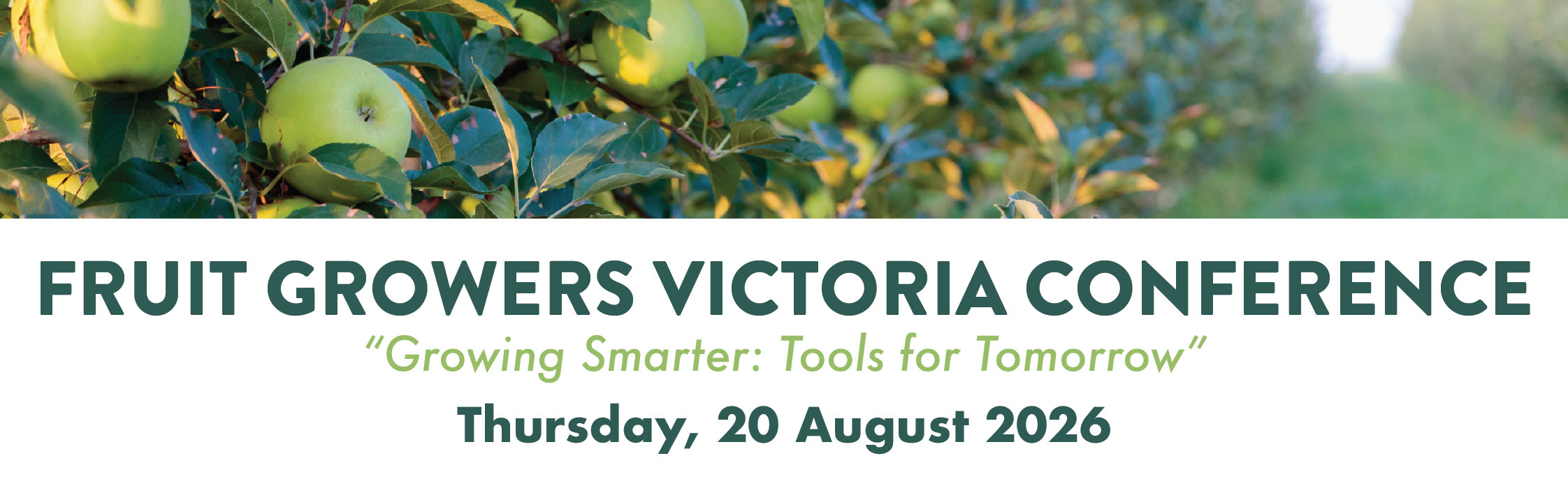
📅 Date: Thursday 20 August 2026
📍 Location: McIntosh Centre, Shepparton, VIC
The Fruit Growers Victoria (FGV) Conference is the must-attend event for Victorian fruit growers in 2026. Designed specifically for growers, the conference provides practical insights, hands-on demonstrations, and opportunities to explore solutions for the challenges facing the horticulture industry today.
What to Expect
- International Guest Speakers – hear from leading experts sharing knowledge and research relevant to Australian growers.
- Live Outdoor Demonstrations – see the latest technologies in action, from orchard management to crop protection.
- Indoor & Outdoor Trade Displays – discover new products, services, and innovations from industry suppliers.
- Networking Opportunities – connect with fellow growers, industry representatives, and suppliers.
Why Attend?
This is a growers-focused conference. Our aim is to:
- Provide updates on the latest technologies and practices for the horticulture sector.
- Highlight solutions to current challenges facing growers.
- Create a space to share knowledge and experiences across the industry.
Registration
Early bird registration opens 1 May 2026. Don’t miss the opportunity to secure your spot at this essential event for growers.
Sponsorship Opportunities
Sponsorship packages are still available! This is a rare chance to showcase your products, network with growers, and gain visibility within the Victorian fruit industry.
Download the Sponsorship Prospectus now or visit the Sponsorship Site to secure your package!!
Whether you're a grower, supplier, or industry professional, this is the event you can’t afford to miss!
Meet Our 2026 Conference Speakers
We’re thrilled to announce the lineup of speakers for the 2026 FGV Conference! These experts bring a wealth of knowledge across horticulture, technology, business, and sustainability, offering valuable insights and practical takeaways for growers and industry professionals.
Visit each speaker’s profile to learn more about their topics and what they’ll be covering at the conference—there’s something for everyone to gain from this year’s program!

Mike Casey
Cherry Orchardist
Central Otago, New Zealand
Mike Casey is an entrepreneur and cherry orchardist from Central Otago who has electrified all the machines on his farm and demonstrated how the transition away from diesel can save farmers tens of thousands each year and significantly reduce emissions. He is also the CEO of Rewiring Aotearoa, a New Zealand charity dedicated to electrifying millions of fossil fuel machines across the motu as quickly as possible. Rewiring Aotearoa’s Electric Homes report proved New Zealand had reached the electrification tipping point, where electric appliances and vehicles were cheaper than their fossil fuel equivalents over their lifetime, even with upfront costs and finance built in. The Electric Farms paper proved there are similar benefits for the rural sector if we can turn farms into power plants. It showed New Zealand’s farmers could reduce their operational costs by going electric and generating a lot of their own electricity through mid-scale solar and battery systems - and they can also make money by feeding electricity back into the grid at times of high demand. “Whether in the home or on the farm, electrification is a real win-win. It’s not just the right environmental decision anymore, it’s the right economic decision. It’s a no-brainer. We just have to figure out how to make it easy.”
..

Dr Patrick H. Brown
Distinguished Professor
University of California, Davis (USA)
Dr Patrick Brown is a Distinguished Professor of Plant Sciences at the University of California, Davis. He completed his B.Sc. at the University of Adelaide, Australia, and his Ph.D. at Cornell University in the USA. In 1988 he identified Nickel as the 14th essential plant nutrient, a discovery that significantly advanced the understanding of plant nutrition.
Dr Brown has authored more than 300 scientific journal articles and several books and is one of the world’s most highly cited experts in plant nutrition, biostimulants, boron, foliar fertilisers and fruit and nut tree horticulture. His work spans both fundamental research and practical applications for agriculture.
He has served on numerous scientific and technical committees for organisations including the US EPA, USDA, California Department of Food and Agriculture and the International Standards Organization (ISO). Dr Brown is internationally recognised as a leading authority on biostimulants in agriculture and has chaired the Biostimulants World Congress since 2012.
Dr Brown has received multiple national and international awards for excellence in research and extension.
..

Jessica Fearnley
Development Officer (Temperate Fruits)
NSW DPIRD
Jessica is passionate about communicating and working with growers and the industry on challenging issues. Her main research areas include developing adaptation strategies to a changing climate, improving soil health and extension. Jessica is the National Extension Manager for the Australian cherry industry and is the project lead for the industry's extension and communication project, funded by Hort Innovation. Jessica is currently studying for her PhD through a partnership between NSW DPIRD and the University of Tasmania and is investigating soil carbon sequestration in perennial orchards.
Jess will be presenting on the different options for control of bats and birds in orchards, and some of the new technologies available to growers in this space.
..

Dr. Lee Kalcsits
Professor of tree fruit physiology
Washington State University Tree Fruit Research and Extension Center
Dr. Lee Kalcsits is a Professor of tree fruit physiology in the Department of Horticulture at the Washington State University Tree Fruit Research and Extension Center in Wenatchee, Washington, USA. He serves as the Endowed Chair of Tree Fruit Environmental Physiology and is also the Director of the WSU Wenatchee Tree Fruit Research and Extension Center. His research program works towards understanding the physiological interactions between environment, horticultural management and genetics of apple, pear, and sweet cherry. This includes applied research in plant nutrition, rootstocks, abiotic stress, and crop load management. He has published more than 150 publications in this research area. He currently leads a large federally funded project that spans seven institutions and 22 senior project personnel. SPARC (Strengthening Pear and Apple Resilience to Climate) seeks to understand, mitigate and predict the impacts of extreme temperatures on pear and apple production in the United States.
..

Don Thorp
Don Thorp is an agricultural consultant specialising in spray application training, assessment, and sprayer performance in the field. With more than 40 years of experience in the horticultural industry, he works with growers, industry organisations, and agricultural suppliers to improve the effectiveness of crop protection practices and getting the best from existing spray machinery.
Over the past six years, Don has operated a specialised spray application training and assessment business, delivering programs to a wide range of clients across the horticulture sector. His work has included projects with key industry and government bodies such as Wine Australia, Almonds Australia, Citrus Australia, Citrus SA, Australian Lychee growers, Avocados Australia, Mangoes Australia, Fruit Growers Victoria and Hort360, as well as collaborations with major agricultural chemical companies and industry suppliers. He has also done many small workshops with individual growers from larger corporate entities to smaller, specialised growers.
Don has also conducted testing and evaluation on approximately 80 different brands, models and types of spray equipment, giving him extensive practical knowledge of spray system performance and application technology.